

Introduction
Shopping has never been the same from one decade to the next, but the pace of change happening right now feels genuinely different. The way people buy groceries, discover products, and interact with stores is shifting rapidly — and at the center of this shift is a concept called Supermaked. It represents a new kind of retail thinking that blends digital integration, smart technology, and a deep focus on the customer experience. This article breaks down everything worth knowing about Supermaked — what it is, how it works, and why it matters for the future of modern retail.
What Is Supermaked?
Supermaked is best understood as an evolution of the traditional supermarket model — one that is smarter, more personalized, and built around the needs of today’s consumer. It is not just a store with a few digital features added on. It is a fundamentally different business model that rethinks how retail operates from the ground up.
At its core, Supermaked combines physical store environments with digital systems to create a seamless experience for every shopper. It uses technology, data, and design to remove friction from the shopping journey and replace transactional retail with something more like relationship-based retail — where the store feels like it actually knows the customer and anticipates their needs.
Think of it as the logical next step in retail evolution — moving beyond the high-volume, low-margin model of traditional supermarkets and toward something more adaptive, intelligent, and human.
The Rise and Evolution of Supermaked
The story of Supermaked did not begin overnight. It grew out of years of frustration with fragmented retail experiences — long checkout queues, inconsistent inventory, impersonal marketing, and a shopping journey that felt more like a chore than a pleasure.
A Brief Timeline of Retail Evolution
| Era | Key Characteristic |
| Traditional retail | Physical stores, manual systems, limited data |
| E-commerce rise | Online shopping, home delivery, price comparison |
| Omnichannel retail | Mixing offline experience with online experience |
| Supermaked era | Fully integrated digital and physical shopping journey |
As consumer expectations grew sharper and technology became more capable, retailers began experimenting with new approaches. Self-checkout arrived. Mobile apps changed how people browsed and compared prices. Loyalty programs started collecting behavioral data. Each step brought retail closer to what Supermaked now represents — an intelligent, adaptive retail environment built on real-time understanding of customer behavior.
The structural shift truly accelerated when e-commerce giants began opening physical stores, and traditional supermarkets started building digital infrastructure to compete. Supermaked emerged from this collision of worlds.
Core Principles Behind Supermaked
What makes Supermaked different is not any single feature — it is the set of principles that guide every decision about how the store works.
The Five Core Principles
- Personalization — every customer receives a tailored experience based on their preferences, browsing history, and purchase behavior
- Efficiency — operations, inventory, and logistics are optimized to reduce waste and speed up service
- Transparency — pricing transparency and honest product information build genuine trust between the store and the customer
- Sustainability — the business model actively reduces environmental impact through eco-friendly packaging, energy efficiency, and local sourcing
- Seamless experience — the line between the online experience and the offline experience is blurred intentionally, giving shoppers a smooth, uninterrupted shopping journey
These principles work together. A Supermaked store that is efficient but not transparent will not build loyalty. One that is personalized but ignores sustainability will fall short of modern consumer expectations. All five principles need to work in harmony.
How Supermaked Differs From Traditional Supermarkets
It helps to put Supermaked side by side with traditional retail to understand just how different the approach really is.
Supermaked vs Traditional Supermarket
| Feature | Traditional Supermarket | Supermaked |
| Checkout | Centralized checkout with queues | Self-checkout, contactless payments, frictionless exit |
| Inventory | Manual stock management | Smart inventory systems with real-time updates |
| Layout | Structured aisles with high-demand items at the back | Intuitive store layout based on customer flow |
| Pricing | Fixed shelf pricing | Dynamic pricing with full pricing transparency |
| Customer relationship | Transactional retail | Relationship-based retail with personalization |
| Data use | Minimal | Deep data-driven decision-making |
| Delivery | Limited or no home delivery | Click-and-collect and home delivery integrated |
The most obvious difference is in the checkout experience. Traditional retail relies on centralized checkout with long queues. Supermaked moves toward self-checkout, contactless payments, and in some cases, checkout-free systems where shoppers simply walk out and are billed automatically.
The bigger difference, though, is philosophical. Traditional supermarkets think about product volume and shelf space. Supermaked thinks about the customer journey from first browse to final purchase — and everything in between.
The Role of Technology in Supermaked
Technology is not an add-on in Supermaked — it is the backbone of the entire operation. From the moment a customer walks through the door (or opens the app), digital systems are working behind the scenes to make the experience better.
Key Technologies Powering Supermaked
- AI and artificial intelligence — used for demand forecasting, personalized recommendations, and smart inventory systems that predict what needs restocking before shelves run empty
- Mobile apps — give customers access to shopping lists, promotions, loyalty programs, and mobile payments before, during, and after their store visit
- Contactless payments — speed up checkout and reduce physical touchpoints for a cleaner, faster experience
- Predictive systems — analyze browsing and purchase behavior to surface relevant products at the right moment
- Real-time updates — keep inventory data accurate across both online and in-store channels simultaneously
- Augmented experience tools — allow shoppers to visualize products, read detailed information, or navigate store aisles via their mobile devices
- Automation — supports retail operations including stock management, distribution, and fulfillment behind the scenes
AI personalization deserves special mention here. The ability to offer each customer relevant recommendations based on their actual behavior — rather than generic promotions — is one of the most powerful shifts Supermaked brings to grocery shopping.
Supermaked Store Design and Customer Experience
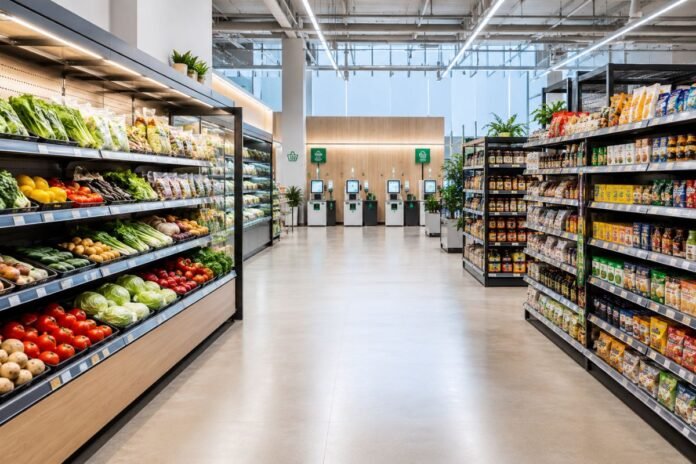
Walk into a Supermaked store and the difference in design is immediately noticeable. The layout is not an accident — every decision about aisles, lighting, navigation, and produce placement has been made with the customer experience in mind.
Design Features That Set Supermaked Apart
- Intuitive environment — store layout guides the customer naturally rather than trapping them in a structured journey they did not ask for
- Clean environment — less clutter, cleaner aisles, and better lighting make the space feel welcoming rather than overwhelming
- Smart navigation — mobile apps or in-store displays help customers find exactly what they need without wandering
- Emotional experience — thoughtful design choices create a shopping atmosphere that feels good to be in, not just functional
- Customer flow — aisles and high-demand items are positioned based on actual movement data, not tradition
- Self-service aisles — give shoppers control over their pace and reduce dependence on staff for routine tasks
The physical store and the digital layer work together rather than competing. A customer might browse online, check what is available via the app, use click-and-collect to pick up their order, and then wander through the store for anything additional — all as part of one seamless experience. That kind of hybrid model is what Supermaked is designed to support.
Benefits of Supermaked for Consumers and Retailers
The appeal of Supermaked is genuinely two-sided. Consumers get a better shopping experience, and retailers get smarter, more efficient operations.
For Consumers
- Greater convenience — less time spent searching, queuing, or waiting
- Personalization means seeing recommendations that are actually relevant
- Pricing transparency builds trust and reduces the anxiety of feeling misled
- Mobile payments and contactless checkout make grocery shopping faster
- Home delivery and click-and-collect options fit around busy modern lives
- Accessibility improves for people who find traditional retail environments difficult to navigate
For Retailers
- Smart inventory systems reduce waste and prevent overstocking or stockouts
- Data-driven decision-making improves everything from promotions to store layout
- Loyalty programs powered by AI deliver better results than generic marketing
- Automation lowers operational support costs over time
- Digital integration enables better supply chain visibility and logistics planning
- The hybrid model opens multiple revenue streams — in-store, online, and delivery systems combined
The efficiency gains alone make Supermaked attractive for any retailer looking to stay competitive. But the deeper value comes from building genuine customer loyalty through an experience people actually enjoy rather than merely tolerate.
Sustainability and Ethical Practices in Supermaked
One of the most meaningful aspects of Supermaked is how seriously it takes sustainability — not as a marketing exercise, but as a core part of how it operates.
Sustainability Commitments in Supermaked
- Eco-friendly packaging reduces plastic use and supports a healthier environment
- Local sourcing and hyperlocal sourcing cut emissions by shortening supply chains
- Energy efficiency measures reduce the carbon footprint of store operations
- Emissions reduction targets are built into the sustainability model from the start
- Waste reduction is supported by smart inventory systems that prevent over-ordering
- Bulk sourcing from trusted suppliers who meet ethical standards adds another layer of responsibility
The sustainability model also extends to how Supermaked treats its employees. Rather than seeing automation as a way to cut people entirely, the best Supermaked implementations use technology for operational support while keeping human interaction central to the customer experience. Empathy and genuine service remain things that no system can fully replace.
Consumers are increasingly aware of how their shopping choices affect the world, and the transparency that Supermaked builds into its operations — around sourcing, pricing, and environmental impact — directly addresses that growing awareness.
Challenges and Controversies Surrounding Supermaked
No retail model is without its complications, and Supermaked is no exception. Several genuine challenges come with building this kind of system at scale.
Key Challenges
- Data privacy — collecting rich behavioral data requires customer trust, and data privacy concerns are real and growing. Shoppers want personalization but worry about how their information is stored and used.
- Accessibility — not every customer is comfortable with apps, mobile payments, or self-checkout systems, which can make Supermaked feel exclusionary to older or less digitally confident shoppers.
- Employees — the role of human employees in increasingly automated stores is an ongoing debate. Balancing efficiency with meaningful employment is a genuine tension.
- Infrastructure costs — building and maintaining the digital systems that power Supermaked requires significant investment, which can be a barrier for smaller retailers.
- Trust — pricing transparency is a promise that needs to be consistently delivered. Dynamic pricing, if poorly communicated, can damage trust rather than build it.
- Digital integration failures — when systems go down or real-time updates fail, the seamless experience breaks down quickly and frustration follows.
These challenges are not reasons to dismiss Supermaked — they are reasons to develop it carefully, with consumer expectations and human needs kept firmly at the center.
Supermaked Around the World
Supermaked is not a single company or a single location — it is a direction that retailers across different continents are moving toward, each in their own way.
Global Adoption Snapshot
| Region | Notable Approach |
| Europe | Strong emphasis on sustainability, eco-friendly packaging, and local sourcing |
| North America | Heavy investment in AI personalization, delivery systems, and e-commerce integration |
| Asia | Leaders in mobile payments, contactless checkout, and fully automated store design |
| Middle East | Rapid adoption of hybrid model retail combining luxury experience with smart technology |
In Asia, mobile-first grocery shopping has normalized the idea of a fully digital retail experience faster than almost anywhere else. In Europe, the sustainability model and supply chain transparency have been the driving forces. North America has invested heavily in data and AI infrastructure, while the Middle East has embraced Supermaked as part of broader smart city development initiatives.
The common thread across all these regions is the same: consumer expectations are rising, and modern retail must evolve to meet them.
Future Trends Shaping Supermaked
Looking ahead, several emerging trends are set to push Supermaked further into the mainstream.
Trends to Watch
- AI personalization at scale — as AI systems become more sophisticated, the recommendations and pricing models they generate will become indistinguishable from genuine human understanding of customer needs
- Augmented experience integration — in-store augmented reality will allow shoppers to see nutritional information, recipe ideas, and sustainability ratings simply by looking at a product
- Predictive systems for demand forecasting — reducing waste and improving efficiency by knowing what customers will want before they do
- Adaptive retail environments — stores that physically change their layout and lighting based on the time of day, customer flow, and seasonal demand
- Fully integrated delivery systems — where home delivery, click-and-collect, and in-store shopping feel like three expressions of the same experience rather than separate services
- Intelligent operations — where backend retail operations run with minimal manual intervention, freeing employees to focus entirely on human interaction and service
- Future retail powered by empathy — the most forward-thinking Supermaked operators understand that technology should enhance human connection, not replace it
The future of Supermaked is not about removing people from the equation — it is about using technology to give both customers and employees more of what they actually value: time, clarity, convenience, and trust.
Conclusion
Supermaked represents something genuinely exciting in the world of retail — a model that takes the best of traditional supermarket familiarity and combines it with the intelligence, personalization, and efficiency that modern consumers have come to expect. It is not a distant concept or a tech experiment. It is already reshaping how grocery shopping works across Europe, North America, Asia, and the Middle East.
For consumers, it promises a shopping journey that respects their time, reflects their preferences, and aligns with their values around sustainability and transparency. For retailers, it offers a path toward smarter operations, stronger loyalty, and a business model built for the realities of modern retail rather than the habits of traditional retail.
Frequently Asked Questions
Q1. What exactly is Supermaked and how is it different from a regular supermarket?
Supermaked is an advanced retail model that blends digital integration, AI, and smart store design to deliver a seamless, personalized shopping experience beyond what traditional supermarkets offer.
Q2. Is Supermaked focused only on technology, or does it still value human service?
While technology powers the system, Supermaked still prioritizes human interaction, empathy, and genuine service as essential parts of the customer experience.
Q3. How does Supermaked handle sustainability?
Supermaked uses eco-friendly packaging, local sourcing, energy efficiency measures, and smart inventory systems to actively reduce waste and lower its environmental impact.
Q4. What are the biggest concerns people have about Supermaked?
Data privacy, accessibility for less digitally confident shoppers, and the impact of automation on employees are the most commonly raised concerns.
Q5. Is the Supermaked model being adopted globally?
Yes, regions including Europe, North America, Asia, and the Middle East are all embracing versions of Supermaked, each shaped by local consumer expectations and retail infrastructure.